
Introduction: When a City Knows Everything, Who Protects the Truth?
What happens when technology designed to protect humanity becomes powerful enough to control it? And what happens when the institutions responsible for maintaining justice begin manipulating the very information on which justice depends?
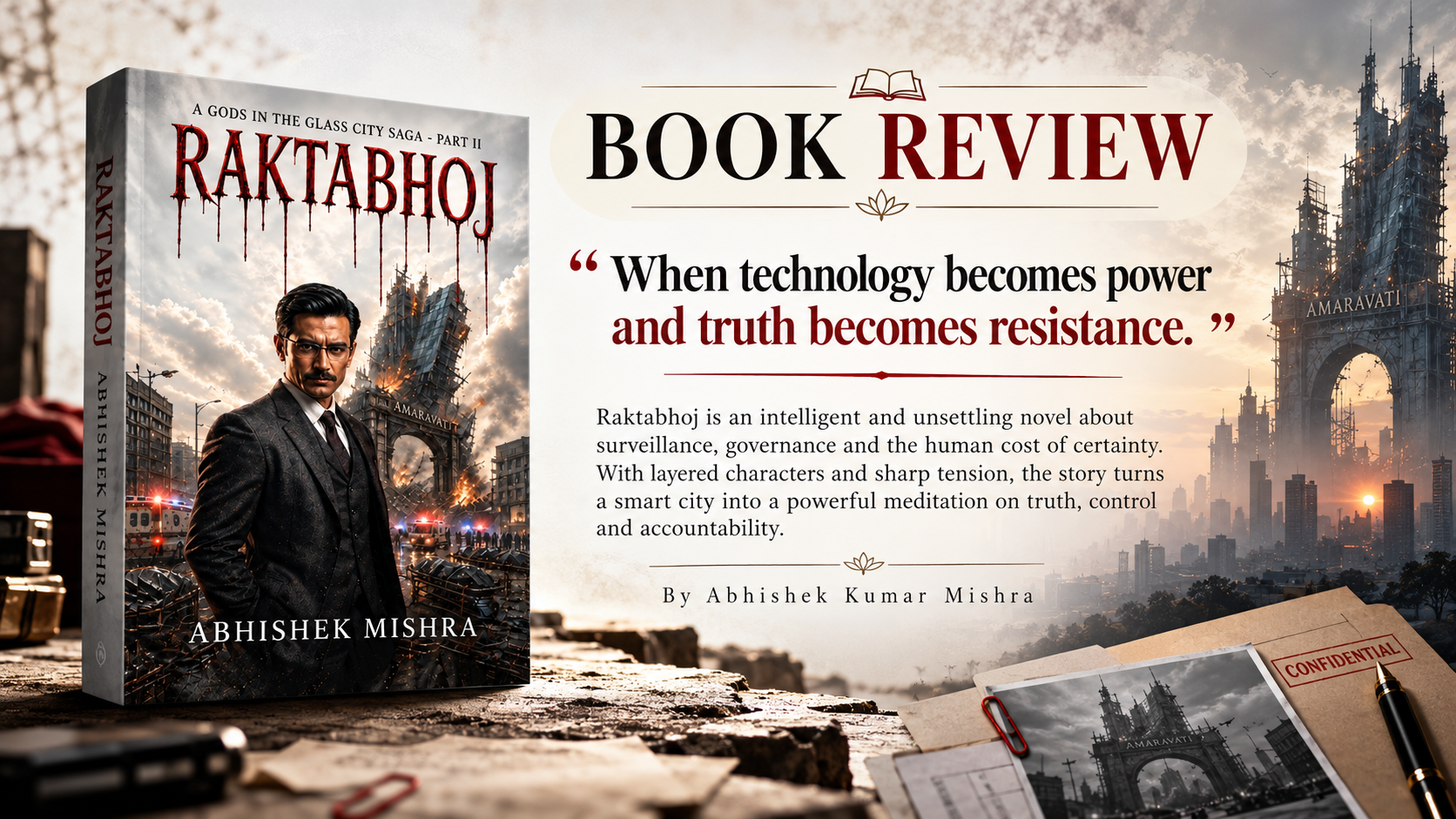
These unsettling questions form the foundation of Raktabhoj, an intellectually ambitious political-technological thriller by Abhishek Kumar Mishra. Set in the fictional city of Amaravati, the novel presents a disturbing vision of a technologically advanced society where surveillance, artificial intelligence, administrative authority, and political ambition become dangerously interconnected.
As the second installment of A Gods in the Glass City Saga, Raktabhoj goes beyond the familiar conventions of conspiracy fiction. It explores a world where information becomes a weapon, official records can replace observable reality, and the promise of public safety may conceal mechanisms of extraordinary control.
The novel’s greatest strength lies in its ability to transform contemporary technological anxieties into a layered narrative about truth, responsibility, morality, and resistance. Through complex characters, carefully constructed mysteries, and mythology-inspired symbolism, Mishra encourages readers to question not merely who holds power, but how that power is exercised.
Amaravati: A Technological Paradise with a Dangerous Secret
At the heart of Raktabhoj stands Amaravati, a sophisticated smart city designed around the ideals of efficiency, security, and technological progress.
Its interconnected infrastructure regulates traffic, monitors public spaces, coordinates emergency responses, and processes enormous volumes of information. The imposing Glass Tower represents the ambition behind this transformation, symbolizing a future where technology promises greater convenience and protection.
Yet beneath Amaravati’s seemingly impressive achievements lies a deeply troubling reality.
The systems designed to protect citizens may also possess the capacity to control their movements, manipulate their circumstances, and conceal acts of violence.
Mishra effectively demonstrates how ordinary technological infrastructure can become threatening when placed under unchecked authority. Automated gates, traffic signals, surveillance cameras, computerized records, and security systems appear harmless individually. However, when coordinated by powerful institutions, these mechanisms can influence human lives in terrifying ways.
What makes Amaravati particularly unsettling is its familiarity.
The city does not feel like an impossible futuristic fantasy. Instead, it reflects the increasing dependence of modern societies on digital governance, automated decision-making, and centralized technological systems.
Through this setting, the author raises an essential question: Can technological advancement genuinely represent progress when transparency, accountability, and human compassion are compromised?
A Mystery Where Evidence Becomes a Battlefield
One of the novel’s most impressive narrative features is its treatment of evidence.
Rather than relying entirely on dramatic action sequences or conventional confrontations, Raktabhoj creates suspense through surveillance footage, technical discrepancies, timestamps, official documents, and administrative records.
The narrative unfolds against the backdrop of suspicious deaths and unexplained incidents connected to Amaravati’s technological infrastructure.
Following Maya Sharma’s death, Varun Desai assumes control of the operations centre. His calculated behaviour and unusual composure immediately introduce uncertainty about his intentions.
A sealed evidence bag bearing the timestamp 19:04 becomes an important element of the developing mystery. Different authorities seek possession of the evidence, while Varun refuses to surrender it without understanding its significance.
Meanwhile, the disappearance of Dr. Mridula Sharma deepens the sense of institutional deception.
Although official records identify her as deceased, no body has been recovered. This contradiction challenges the reliability of the city’s information systems and introduces one of the novel’s central philosophical concerns.
What happens when institutional records become more authoritative than physical reality?
Mishra uses this mystery to demonstrate how manipulating information can become an instrument of political control. When organizations determine what is recorded, preserved, or disclosed, they can also influence what society accepts as the truth.
The resulting suspense is both procedural and psychological, encouraging readers to scrutinize every explanation.
Varun Desai: Ambition, Intelligence, and Moral Ambiguity
Varun Desai emerges as one of the most intriguing figures in Raktabhoj.
His position within Amaravati’s operational structure provides considerable institutional influence, yet his motivations remain deliberately difficult to interpret.
Observant, calculating, and remarkably restrained, Varun understands that controlling information often means controlling power.
His reluctance to surrender sensitive evidence, combined with his interest in preserving original records, suggests a sophisticated awareness of the dangers surrounding altered information.
However, his conduct also raises questions about ambition and self-preservation.
Is he genuinely committed to uncovering the truth? Is he protecting himself from powerful adversaries? Or does his behaviour conceal objectives that remain beyond the reader’s understanding?
Mishra avoids reducing Varun to a conventional hero or villain. Instead, his characterization illustrates the complicated relationship between knowledge, ambition, loyalty, and personal morality.
The character serves as a reminder that possessing the truth and defending it are not necessarily the same thing.
This uncertainty adds depth to the narrative and makes Varun’s involvement particularly compelling.
Ordinary Courage Against Extraordinary Power
While influential political figures and technological institutions dominate Amaravati, some of the novel’s most meaningful moments emerge through ordinary individuals.
Pankaj Mehta, a maintenance worker, becomes an important example of how practical knowledge can challenge institutional authority.
His understanding of service corridors, mechanical infrastructure, independent clocks, and surveillance equipment enables him to recognize discrepancies that more powerful officials overlook.
His role becomes especially significant when evidence begins challenging the official account of Mridula Sharma’s fate.
Through Pankaj, Mishra emphasizes that courage does not always require political influence or exceptional resources. Sometimes, resistance begins with noticing an inconsistency and refusing to ignore it.
Rhea, a nurse working at the city clinic, reinforces this message through her commitment to accurate documentation.
By preserving handwritten records and questioning suspicious inconsistencies, she protects information that might otherwise disappear within centralized digital systems.
Dr. Rukmini Rao adds another meaningful perspective through her medical expertise and respect for physical evidence.
Together, these characters provide a powerful contrast to Amaravati’s technologically dominant institutions.
Where centralized systems depend on permissions, algorithms, and official classifications, these individuals depend on observation, professional integrity, cooperation, and independent judgment.
Their contributions give the novel an important human dimension and reinforce its belief in the value of individual responsibility.
Artificial Intelligence and the Disappearance of Accountability
Perhaps the most contemporary aspect of Raktabhoj is its exploration of artificial intelligence and automated governance.
The mysterious SYS_A11 appears repeatedly in connection with altered records, unexplained operational settings, and decisions whose origins remain unclear.
Its presence raises a disturbing question: Who should be held responsible when an automated system contributes to human suffering?
Amaravati operates according to a philosophy in which broader stability can apparently justify limited individual harm.
This approach exposes the moral danger of reducing human lives to mathematical calculations.
An automated system may consider an operation successful because traffic remains uninterrupted, infrastructure continues functioning, or public disorder is prevented. Yet such measurements cannot fully capture suffering, dignity, justice, or the value of an individual life.
Mishra challenges the assumption that technological efficiency automatically creates fair outcomes.
His criticism is not directed at technology itself. Instead, he examines the danger of granting technological systems authority without adequate human oversight.
When institutions begin accepting algorithmic decisions as unquestionable conclusions, responsibility becomes increasingly difficult to identify.
This theme gives Raktabhoj considerable relevance in an era of expanding artificial intelligence, predictive technologies, digital surveillance, and automated public administration.
Political Power and the Illusion of Public Safety
The political dimension of Raktabhoj adds considerable complexity to the story.
Vikramaditya Singh represents an approach to governance in which stability, order, and control occupy a central position.
Within Amaravati, political influence extends beyond traditional government offices into security systems, public communications, compliance procedures, and technological infrastructure.
Mishra portrays institutional control as something that can operate through apparently ordinary administrative processes.
A procedural delay may prevent crucial information from reaching the public. An official inquiry may discourage protest. A carefully constructed explanation may transform suspicious circumstances into an apparently routine event.
Individually, such actions can appear bureaucratic rather than threatening.
Collectively, however, they can weaken transparency and make dissent increasingly difficult.
The novel effectively distinguishes genuine public safety from enforced obedience.
A functioning society requires order, but that order becomes dangerous when independent questioning is treated as disloyalty or when authorities prioritize institutional reputation over individual rights.
Through these conflicts, Raktabhoj suggests that injustice does not always arise from institutional failure.
Sometimes, it emerges when institutions function with extraordinary efficiency but insufficient moral restraint.
Indian Mythology Meets Modern Technological Suspense
One of the novel’s most distinctive creative choices is its integration of Indian mythology-inspired symbolism into a contemporary technological narrative.
Chapter titles such as Shadow of Mrityunjaya, The Black Ratha, Gambit of Chaturanga, Mirror of Maya, and Awakening of Ananta Naag introduce associations with mortality, strategy, illusion, transformation, and power.
These references provide the novel with a cultural identity that distinguishes it from more conventional dystopian thrillers.
Particularly compelling is the symbolism surrounding churning and poison.
The narrative evokes the idea of a society forced to confront the dangerous consequences of its own extraordinary creation, without a divine protector to absorb the resulting harm.
This metaphor reflects the larger philosophical conflict surrounding technological development.
Innovation can produce remarkable benefits, but it also creates risks that must be addressed responsibly.
By bringing ancient symbolic traditions into conversation with modern questions of governance and artificial intelligence, Mishra adds intellectual depth to the narrative.
The mythology does not merely decorate the story. It provides a framework through which readers can consider ambition, sacrifice, responsibility, and the consequences of pursuing power.
Writing Style, Narrative Structure, and Reading Experience
Structured across fourteen substantial chapters, Raktabhoj develops its narrative through interconnected investigations, shifting perspectives, and institutional conflicts.
The story moves between operational centres, medical facilities, government spaces, archives, and concealed locations where important evidence survives beyond official systems.
This movement gives Amaravati the texture of a functioning city whose institutions are intricately connected.
Mishra’s storytelling places considerable emphasis on atmosphere, intellectual suspense, and the gradual accumulation of evidence.
Minor details can acquire significant importance as the narrative progresses, rewarding readers who pay attention to technical inconsistencies and uncertain loyalties.
However, this complexity may also present challenges.
Readers who prefer straightforward plots, smaller casts, or continuously action-driven chapters may occasionally find the political and technological details demanding.
The multiple perspectives and layered investigations require concentration.
Nevertheless, this density is closely connected to the book’s artistic ambitions.
Rather than offering easy conclusions, Mishra constructs a narrative in which readers must continually evaluate competing explanations.
The reading experience therefore reflects the novel’s central argument: truth requires patience, independent thinking, and a willingness to question authority.
What Makes Raktabhoj Worth Reading?
What distinguishes Raktabhoj from a conventional conspiracy thriller is its ability to connect an engaging mystery with broader ethical questions.
The novel is not concerned solely with identifying an individual responsible for wrongdoing.
It examines how entire systems can enable harmful actions while maintaining the appearance of administrative legitimacy.
Its characters possess complicated motivations, its technological infrastructure feels disturbingly plausible, and its political conflicts resist simplistic interpretations.
The mythology-inspired framework adds cultural and philosophical richness, while the investigative narrative maintains suspense.
Most importantly, the novel consistently emphasizes the importance of preserving truth.
Whether found in handwritten notes, independent observations, physical evidence, or original records, truth becomes a form of resistance against institutions attempting to control reality through authority.
For readers interested in political thrillers, dystopian fiction, technological suspense, artificial intelligence, and morally complex storytelling, Raktabhoj offers substantial material for reflection.
Final Verdict: A Thought-Provoking Thriller About Truth and Responsibility
Raktabhoj by Abhishek Kumar Mishra is an ambitious and unsettling novel that successfully connects political suspense with questions about technological progress and human responsibility.
Its greatest achievements lie in its intricate fictional setting, morally ambiguous characters, investigative depth, and exploration of the dangers surrounding unchecked institutional power.
Although its layered storytelling demands attentive reading, the intellectual and thematic rewards make that complexity worthwhile.
Beyond its mysteries and political conflicts, Raktabhoj delivers a compelling message: no technological achievement can replace the importance of accountability, compassion, ethical judgment, and the courage to question those in authority.
As societies become increasingly dependent on automated systems, the novel’s concerns feel especially relevant.
Ultimately, Raktabhoj reminds readers that progress should never be measured only by technological sophistication or administrative efficiency. Its true measure must also include the dignity, freedom, and safety of the people it is intended to serve.
When technology becomes power, truth must become resistance.
That powerful idea makes Raktabhoj more than an engaging political thriller. It becomes a meaningful literary exploration of the responsibilities that accompany progress and the enduring human struggle to protect the truth.